
A guide to watcher collection mechanics, explaining how they work, and how to most effectively use and collect rainwater.
Overview
Roofs have a handy little note that states “redirects rainwater”. This allows them to act as “sub rain collectors” in their own right, and at only 5 wood a piece, allows you to reduce the amount of more valuable resources that you would spend on building multiples of the primary structures.
This can make such a massive difference to the point that your water and power needs can subsist almost entirely on rain with the right setup, assuming you have enough storage for each.
Roofs
Remember the Water Collector stat from before?
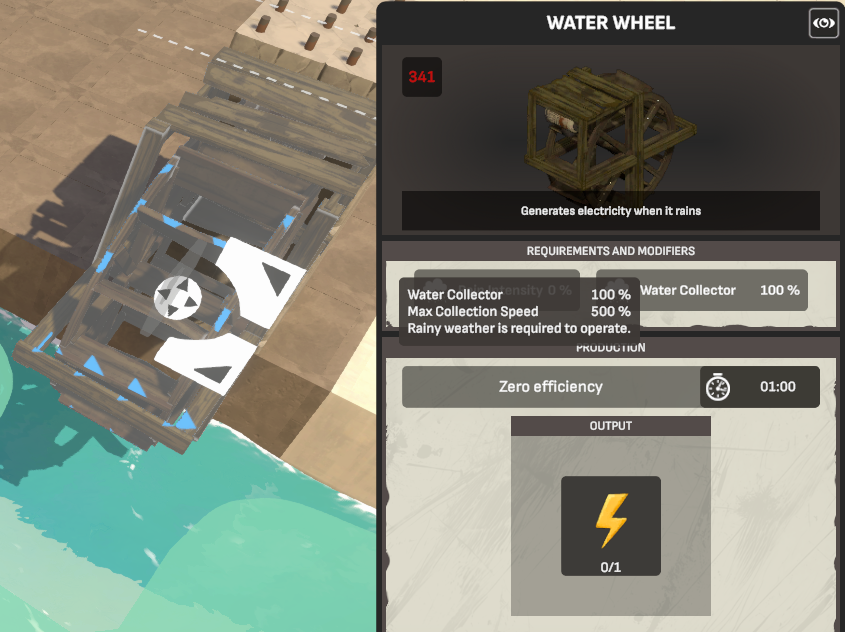
That is how much water is being directed into the structure. By default, this is at 100%, assuming the structure is fully exposed to the sky. Every full roof that drains water into it adds another 100% to this stat (the curved half roof only adds 50%), up to a maximum of 500% for the Raincatcher and Water Wheel. In other words, you can and should direct up to 4 normal roofs’ worth of water into the first two structures. Anything more than this for a single structure is wasted.
In more specific terms, Raincatchers and Water Wheels can collect up to 20 blocks worth of rain exposure, with each block contributing 25%. This may be relevant if you find yourself trying to maximize rain collection and have to get creative with where you’re placing your roofs. This can be broken down further into individual tiles (4 per block, each contributing 6.25%), but if you’re sloppy enough with your builds that this is relevant, you have much bigger problems.
To get max efficiency from the Pumpkin Farm, you can generally build them in pairs, with a single curved half roof draining half of itself into each farm to hit the cap of 125%.
Observe the following GIF, as it illustrates multiple principals, as well as acts as a good template for a perfectly 5×5 square and fully 500% effective 5-raincatcher setup, or, the 5x5x5x5:
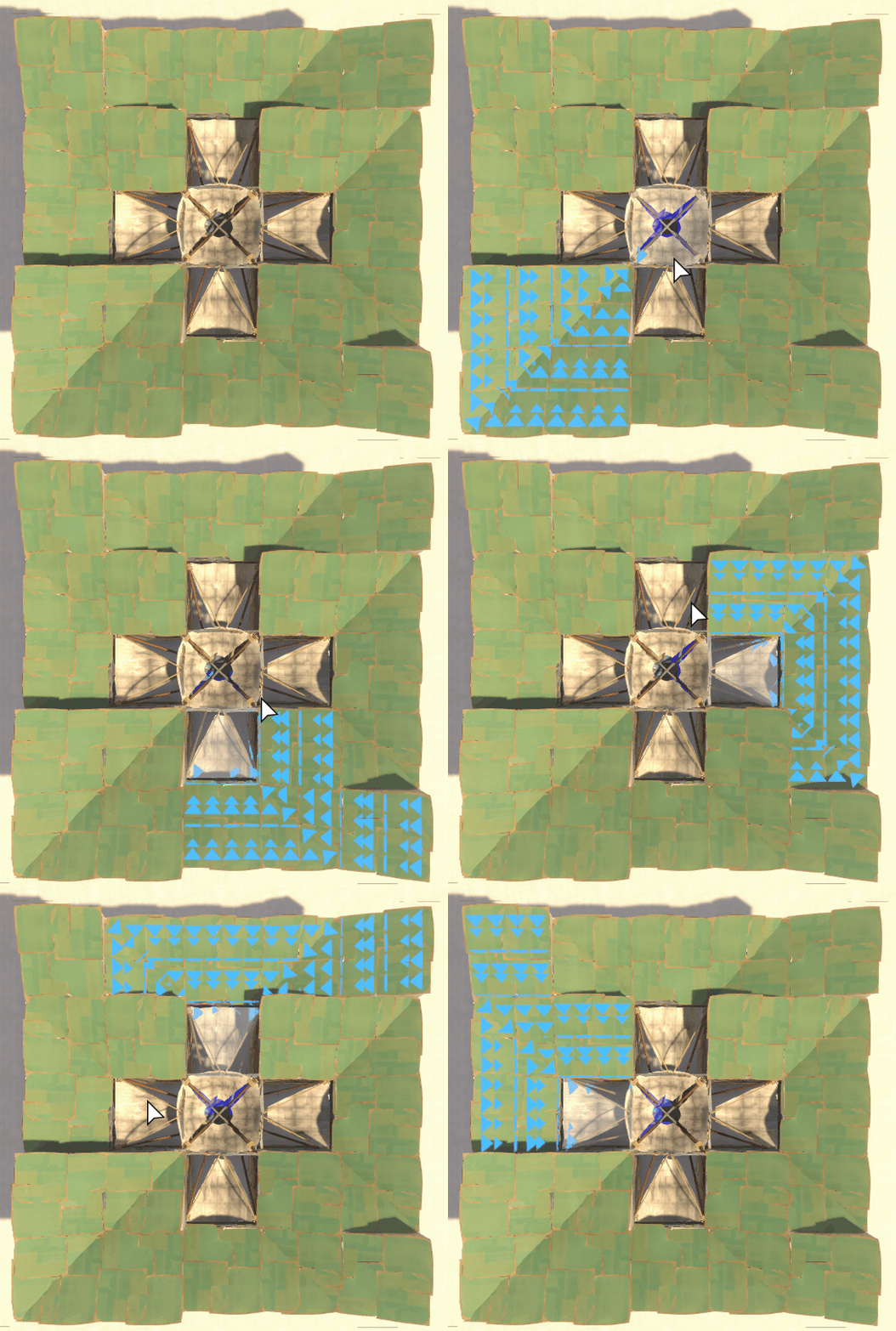
Water flows logically for each roof shape, from top to bottom, and each roof adds the water flow from previous roofs to its own, meaning that you don’t need every roof to directly drain into the structure. Clicking on a roof or water collecting structure will display blue arrows for every roof that leads up to it. The arrows speed up as more water accumulates, and will be completely stationary if that tile could collect water, but can’t at the moment, either from something above blocking it or simply because it’s not raining at the moment.
Roofs can have multiple output directions. The inverted V roof will split water in two directions, allowing you to, for example, set up an earlier system of roofs that accumulate a total of 700% rain collection that lead to the inverted V roof, which adds its own 100% for a total of 800%, and then splits it into two 400% streams that can then go into two structures.
The center peak roof will redirect water in 8 directions, and the corner roof will split it into thirds. I think.
I do not recommend using these two roof types for rainflow directing, as it’s hard to make rain from previous roofs flow into them in a way that will evenly split the input.
Something to note is that the inverted corner roof outputs water to a single tile diagonally away from its model. In the following emoji illustration, each square represents a single tile. Arrows are the direction of water flow, and the blue tile is where its water actually outputs to:
↘️🟩🟩⬇️
🟩↘️🟩⬇️
🟩🟩↘️⬇️
➡️➡️➡️↘️
⬛⬛⬛⬛🟦
This is primarily important in the GIF for getting water to the center raincatcher. You can get water to the outer raincatchers using nothing but normal roofs and some extra elevation, but inverted corners allow for more compact and cleaner builds.